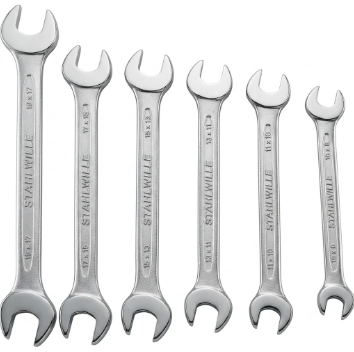
An open-ended spanner (or open-end wrench) is a multi-purpose hand tool engineered to tighten or loosen hexagonal or square fasteners, particularly in situations where vertical clearance is limited. Its technical architecture consists of a single, solid piece of drop-forged alloy steel—typically chrome-vanadium—comprising a flat central handle (shank) with U-shaped jaws at both ends. The internal parallel faces of these jaws are precision-machined to exact tolerances to match specific nut or bolt sizes. To maximize efficiency in tight configurations, the heads are typically angled at $15^{\circ}$ relative to the longitudinal axis of the handle. This design offset allows the tool to be flipped over repeatedly, effectively doubling the number of access angles available to engage the fastener flats in confined structural pockets.
Operation relies on lateral jaw engagement and manual lever force to rotate fasteners smoothly. The operator slides the open jaw horizontally onto the flats of the bolt head or nut from the side, ensuring full, flush contact with the parallel metal walls to avoid rounding off the fastener’s corners. Holding the handle firmly, the user applies manual linear force perpendicular to the shank, turning the tool clockwise to tighten or counter-clockwise to loosen the component. In restricted environments where a full swing is impossible, the operator turns the fastener through a partial arc, slides the wrench off, flips it over to exploit the $15^{\circ}$ head angle, and re-engages the flats to continue the rotational cycle.