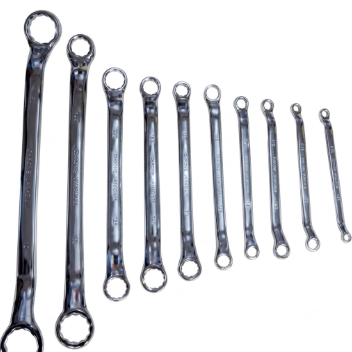
A double-ended ring spanner (or box wrench) is a handheld mechanical tool engineered to wrap entirely around hexagonal or square fasteners to apply high torsional force without slipping. Its technical architecture consists of a rigid, one-piece forged body made of high-tensile alloy steel—typically chrome-vanadium—featuring closed, circular profile loops (rings) at both ends of a central connecting shaft. The interior of each ring is precision-machined with a multi-point profile, most commonly 12-point (bi-hexagon) geometries, which allows the tool to engage a nut or bolt head at twice as many angles as a standard 6-point wrench. To protect the operator’s hands and provide clearance over flat surfaces, the rings are typically offset at a $15^{\circ}$ angle relative to the main shaft, and each end is sized differently (e.g., $10\text{ mm}$ on one side and $11\text{ mm}$ on the other) to maximize tool versatility.
Operation relies on complete circumstantial contact and manual leverage to safely rotate tight fasteners. The operator selects the correct ring size and slips it vertically over the head of the bolt or nut, ensuring that the internal 12-point teeth completely envelop the fastener’s flats. Because the closed loop distributes the manual pulling force evenly across all corners of the bolt head, the risk of rounding off the fastener or having the tool slip off under heavy load is virtually eliminated. The user applies firm linear force to the opposite end of the shaft, pulling or pushing in a clockwise direction to tighten the fastener or counter-clockwise to loosen it. The offset head allows the user to rotate the bolt smoothly even when working flush against a flat panel or engine block.