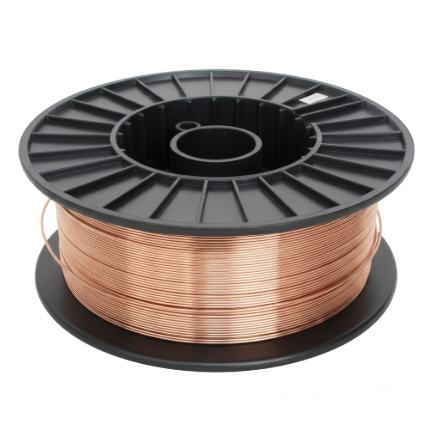
Technical Description: MIG welding wire is a continuous consumable electrode used in Metal Inert Gas (MIG) or Gas Metal Arc Welding (GMAW) processes to join ferrous and non-ferrous metals. It is manufactured from high-quality steel, stainless steel, aluminum, or other alloys and is supplied on spools in various diameters to suit different welding applications. The wire is fed automatically through a welding gun, where it serves as both the electrode and the filler material. Depending on the material being welded, MIG wire is used with a shielding gas such as carbon dioxide (CO₂), argon, or argon-based gas mixtures to protect the molten weld pool from atmospheric contamination. MIG welding wire is widely used in automotive manufacturing, structural steel fabrication, shipbuilding, pipeline construction, and general metal fabrication due to its high deposition rate, strong weld quality, and efficient operation.
Operation: To operate MIG welding wire, the spool is mounted on a MIG welding machine and fed through the wire feed mechanism into the welding gun. The appropriate wire diameter, feed speed, voltage, and shielding gas are selected according to the material thickness and welding requirements. When the welding gun trigger is pressed, the machine simultaneously feeds the wire, supplies electrical current, and releases shielding gas. An electric arc forms between the wire and the workpiece, melting both the wire and the base metal to create a strong welded joint as the operator moves the welding gun steadily along the joint. After welding, the joint is allowed to cool naturally and is inspected for weld quality. For safe and effective operation, the correct wire type, shielding gas, and welding parameters must be used, and the wire should be stored in a clean, dry environment to prevent rust or contamination that could affect weld performance.