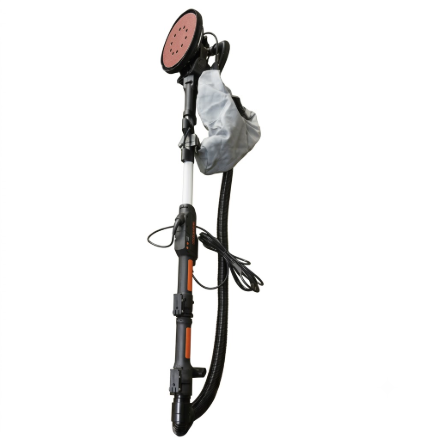
Technical Description: A drywall sander is a power tool designed for sanding drywall joints, plaster, ceilings, and wall surfaces to produce a smooth, uniform finish before painting, wallpapering, or other finishing applications. It typically consists of an electric motor, a circular sanding pad with a hook-and-loop backing for attaching abrasive discs, an extendable handle, a gear-driven or direct-drive mechanism, and an integrated dust extraction system that connects to a vacuum or dust collection bag. The sanding head is often mounted on a flexible pivot, allowing it to follow uneven surfaces and reach corners and ceilings with minimal effort. Drywall sanders are widely used in construction, renovation, and interior finishing due to their ability to increase productivity, reduce operator fatigue, and minimize airborne dust.
Operation: To operate a drywall sander, the appropriate grit sanding disc is attached securely to the sanding pad, and the dust extraction system is connected to a compatible vacuum or dust collector. The tool is switched on and placed gently against the drywall or plaster surface, allowing the rotating sanding pad to remove excess joint compound, plaster, or surface imperfections. The operator moves the sander slowly in overlapping circular or sweeping motions while applying light, even pressure to achieve a smooth and level finish without damaging the surface. Upon completion, the tool is switched off, the sanding disc is inspected or replaced if worn, and the dust collection system is emptied and cleaned. Regular maintenance, including checking the motor, sanding pad, and dust extraction components, ensures efficient performance, extended service life, and safe operation.